
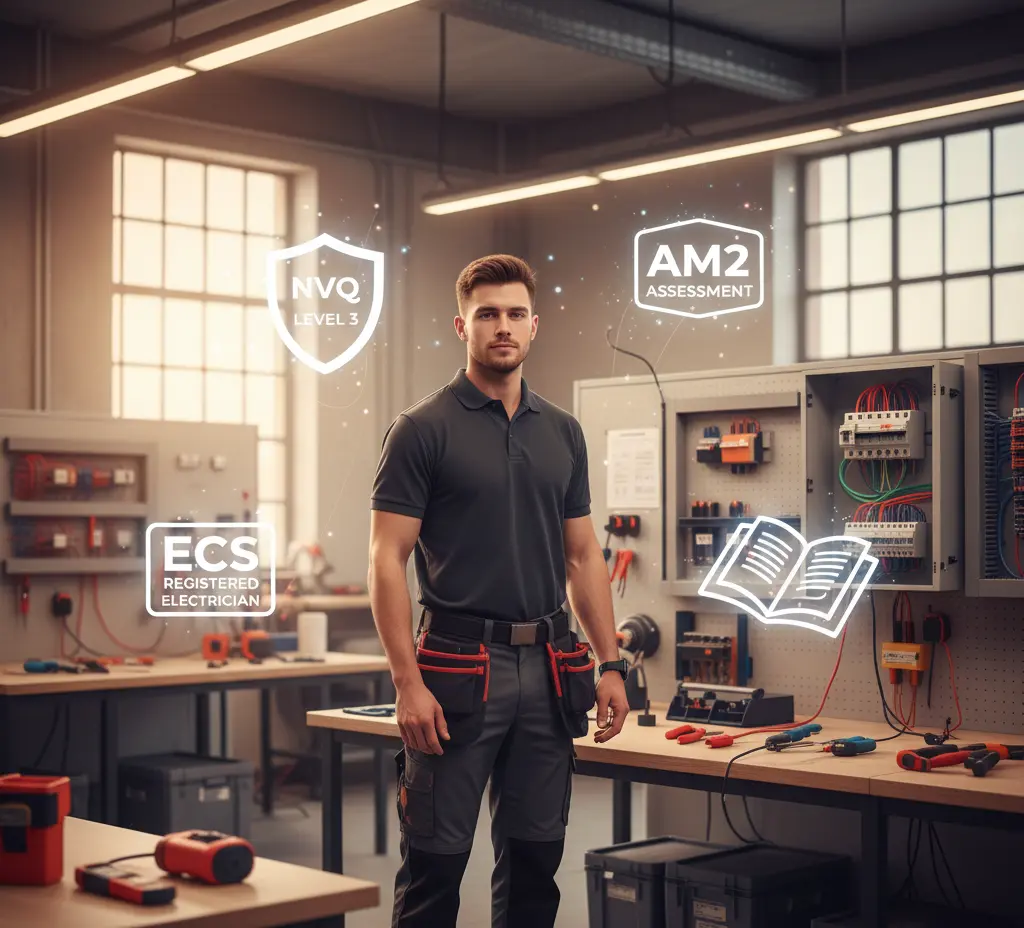
There is something powerful about choosing a career that is both practical and respected. Become a qualified electrician in the US gives you the chance to build a stable future, earn strong wages, and develop skills that will always be in demand, from domestic installations to renewable energy and smart home technology. Becoming a qualified electrician in the US gives you the chance to build a stable future, earn strong wages, and develop skills that will always be in demand. Whether you are a school leaver, a career changer, or someone who has always enjoyed hands on work, the electrical trade opens a world of opportunities, from domestic installations to commercial projects, renewable energy, and smart home technology.
But the path can feel confusing, especially if you are just getting started. You might hear terms like NVQ Level 3, AM2 Assessment, apprenticeships, ECS cards, or 18th Edition Wiring Regulations and wonder what they actually mean. It is normal to feel overwhelmed. Every qualified electrician in the US started exactly where you are right now.
Let us walk through this step by step. By the end, you will understand exactly what qualifications you need, how long it takes, how much it costs, and the smartest way to build a career you can be proud of.
Why Become a Qualified Electrician in the US?
Before diving into the steps, let us talk about why this career path is so rewarding.
- Strong earning potential, even early in your career
- Job security, because electricians will always be needed
- Opportunities for self employment, giving you independence
- Hands on work, ideal if you prefer practical tasks over desk work
- Clear progression routes, including inspection, testing, and management
- Increasing demand, especially in renewable energy and EV charging
Electricians are one of the few professions consistently listed in US skills shortage reports. This means the industry needs you.
Step 1, Understand the Qualifications You Need
To become a fully qualified electrician in the US, you typically need four key components:
- Level 2 Diploma in Electrical Installation
- Level 3 Diploma in Electrical Installation
- NVQ Level 3 (On Site Portfolio)
- AM2 Assessment (Your Final Trade Test)
Let us break down what each one actually means.
Level 2 Diploma in Electrical Installation
This is your starting point. It introduces you to:
- Electrical principles
- Health and safety
- Circuit structure
- Installation methods
- Basic wiring
This qualification gives you your first real taste of the trade and helps you understand whether electrical work suits your strengths.
Level 3 Diploma in Electrical Installation
This is more advanced and covers:
- Inspection and testing
- Detailed wiring regulations
- Advanced electrical science
- Complex installation techniques
Once you finish Level 3, you will have the theoretical knowledge needed to work safely and confidently.
NVQ Level 3 Electrical Installation
This is not a classroom qualification. It is a portfolio of real, on site electrical work that demonstrates your competence. You gather photos, written evidence, job logs, and witness testimonies. It proves you can:
- Install wiring systems
- Follow regulations
- Solve electrical faults
- Work safely on active sites
- Communicate effectively with clients
Most learners complete their NVQ while working as an apprentice or improver.
AM2 Assessment
The AM2 is your final trade test. It is a practical exam that lasts around two and a half days. You complete:
- Fault finding tasks
- Safe isolation procedures
- Full installation work
- Inspection and testing
- Written assessments
Passing the AM2 officially confirms that you are competent to work as a qualified electrician.
Once you finish these four steps, you can call yourself a fully qualified electrician in the US.
Step 2, Choose Your Training Route
There are two main ways to become qualified. Both are valid, but one might suit your situation better.
Route 1, Apprenticeship (Best for School Leavers)
This is the most traditional path. You work for an employer while studying part time. It usually takes three to four years and includes:
- Level 2 Diploma
- Level 3 Diploma
- NVQ Level 3
- AM2 Assessment
You are also paid while you learn, which makes this route popular for younger learners. Best for, School leavers, students, and hands on learners.
Route 2, Private Training (Best for Adults or Career Changers)
If you are older, or you cannot secure an apprenticeship, private training centres offer fast track or flexible options.
You can complete:
- Level 2 and Level 3 Diplomas in the classroom
- NVQ Level 3 through on site assessments
- AM2 through approved test centres
This route can be quicker, but you must gain on site experience to complete the NVQ. Best for, Career changers, adults who need flexibility, and people who prefer structured teaching. Need to budget for training? Review typical course costs and flexible payment plans offered by various providers before committing to a center. See price estimates for Level 2 & 3 Electrical Courses.
Training Routes
| Feature | Apprenticeship Route | Private Training (Fast-Track) |
| Duration | 3 – 4 Years | 18 Months – 3 Years |
| Cost | Often funded (Earn while you learn) | Self-funded (Flexible payments) |
| Best For | School leavers & hands-on learners | Career changers & adult learners |
| Outcome | Fully Qualified Status | Fully Qualified Status |
Step 3, Register for an ECS Card
The ECS Card is your proof that you have the skills and safety knowledge to work on US construction sites. Most employers will not let you on site without one.
You start with:
- ECS Labourer Card Then progress to
- ECS Electrician Card after gaining your qualifications
This is similar to the CSCS card used in other trades.
Step 4, Build Experience on Site
The best electricians are not just technically skilled, they also understand how real work environments operate. You learn how to communicate with site supervisors, read plans, manage time, and troubleshoot unexpected problems.
On site experience helps you develop:
- Practical wiring skills
- Teamwork and communication
- Confidence using tools and equipment
- Professional problem solving
- Realistic expectations of electrical work
Experience shapes you into a competent, employable electrician.
Step 5, Complete the NVQ and AM2
The NVQ is often the longest stage because it depends on the variety of work available. You need evidence from different types of installations, such as:
- Domestic wiring
- Commercial projects
- Containment systems (trunking, conduit, tray)
- Inspection and testing
- Health and safety compliance
Once your NVQ is complete, you book your AM2 assessment. Passing this exam is your final milestone.
Step 6, Become Fully Qualified and Join a Competent Person Scheme
Once you finish your AM2, you can join registration bodies such as:
- NICEIC
- NAPIT
- ELECSA
These organizations allow you to sign off your own electrical work, particularly in domestic settings, without needing building control approval each time.
This step opens the door to self employment, higher pay, and more advanced responsibilities.
How Long Does It Take to Become a Qualified Electrician in the US?
- Apprenticeship route, 3 to 4 years
- Private training route, 18 months to 3 years
- Adult learners with full time commitment, sometimes faster
It depends on your schedule, your access to work experience, and the training pathway you choose.
How Much Can You Earn as an Electrician in the US?
Electrical work pays well because the skills are in demand.
- Trainee or improver, £15,000 to £21,000
- Newly qualified electrician, £28,000 to £35,000
- Experienced electrician, £35,000 to £45,000
- Self employed electrician, £40,000 to £60,000+
Specialist areas like solar installation, EV charging, and industrial maintenance can pay even more.
Tips for Succeeding as a New Electrician
- Be reliable. Turning up on time builds trust.
- Ask questions. Curiosity helps you learn faster.
- Take health and safety seriously.
- Build strong relationships with site teams.
- Stay updated with wiring regulations.
- Keep your tools clean and organized.
- Record your NVQ evidence carefully from day one.
Your attitude is often just as important as your technical skills.
A Final Word of Encouragement
Becoming a qualified electrician in the US is a journey filled with hard work, long days, and moments when you doubt yourself. But it is also a path filled with growth, confidence, and real pride. There is nothing quite like wiring your first circuit, solving your first fault, or passing your AM2 after months of commitment.
If you are willing to learn, stay patient, and trust the process, you will get there. Every electrician you admire started exactly where you are now. Your future is wired with possibility.
Frequently Asked Questions (FAQs)
Q1: What is the AM2 assessment?
Ans: The AM2 is a 2.5-day practical exam that serves as the final trade test to confirm an electrician’s competence.
Q2: How much can a self-employed electrician earn?
Ans: Experienced self-employed electricians can earn £40,000 to £60,000+ per year in 2025.
Q3: Is the 18th Edition Wiring Regulation mandatory?
Ans: Yes, staying updated with current wiring regulations is essential for safety and legal compliance on-site.