Introduction: The Reality of Fast-Paced Work
If you have ever sprinted through a lunch rush, juggling a headset, a fry basket, and a customer asking for extra ketchup, you know this work is no joke. So is McDonalds blue collar job, not quite in the traditional sense. It sits in the service sector, which is different from the classic trades, but the work is physical, fast, and incredibly disciplined, which is why people debate the label in the first place.
Learn why even cleaning jobs can teach important career lessons in mcdonalds blue collar job Value.
Why People Ask This Now
You see the question everywhere because job categories shape how we honor work. Blue collar still conjures steel, sawdust, tool belts, and union cards. White collar conjures spreadsheets, meetings, and a blowout sale on office chairs. Fast food does not fit cleanly into either basket, so it gets mislabeled or overlooked. Add in social media clips arguing that “anyone can do it,” and you get a narrative that underestimates the skill it takes to run a tight shift at 12:15 on a Tuesday. The reality, most economies now run on services, and service work deserves clarity and respect on its own terms.
Answer in Plain English: Service vs. Blue Collar
| Feature | Blue Collar Trades | McDonald’s Service Roles |
| Primary Goal | Repair/Build Infrastructure | Customer Experience & Food Safety |
| Training | Apprenticeship/Trade School | On-the-job/Operational Training |
| Tools | Industrial Tools/Machinery | POS Systems/Kitchen Technology |
| Sector | Industrial/Construction | Service Economy |
Traditional blue collar jobs are hands-on roles in the trades and industrial sectors. Think construction, electrical, plumbing, machining, facilities maintenance, utility linework, and manufacturing plants. These jobs usually involve making or fixing physical things, often require a license or apprenticeship, and rely on tools, machines, and safety protocols that are tied to heavy industry.
McDonald’s frontline roles are part of the service economy. The product is an experience built through speed, consistency, food safety, and customer care. That means the industry is different, the skills are different, and the training is different. If you need a clean label, McDonald’s crew roles are service jobs. Some people call them grey collar because they mix physical work with customer interaction and tech-driven systems. The label matters less than the truth behind it. This job is tough, it is technical in its own way, and the best crews run like a Formula One pit stop.
Curious about industry-specific blue-collar opportunities? Check Job for a Driller.
The World Behind the Counter
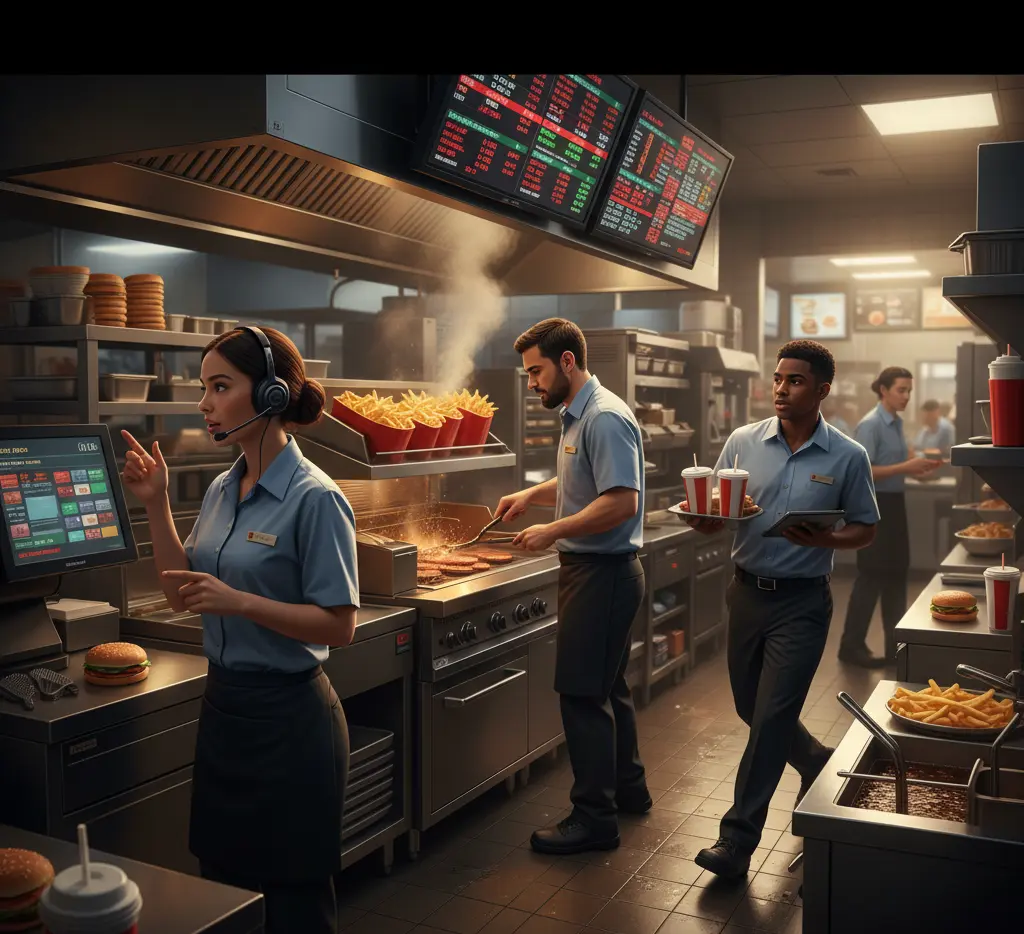
Step into a busy store and you will see a choreography you might not clock at first. There is the headset rhythm at drive-thru, order taking, repeat back, lane management, and polite boundary setting when chaos nudges the line. There is the kitchen cadence, drop times for fries, holding times for nuggets, grill marks for patties, and bin management that keeps waste low and freshness high. There is the front counter flow, reading a stranger’s mood in half a second, handling cash, the double check on allergen notes, and a smile that does not tip into fake. There is cleaning, there is stocking, there is temperature logging for food safety. Doing all of that at speed without shortcuts is a craft.
Technology and Operations Management
And it is not just bodies moving. Modern stores run on software. KDS screens stage orders, sensors track fryer cycles, digital thermometers verify safe holds, and mobile orders collide with in-store traffic patterns. A strong shift lead can look at a screen and predict bottlenecks two minutes out. They reassign a runner, they open a second ice cream station, they move a fast cashier to drive-thru because headsets are backed up. It is a live operations problem. The tools have changed. The stakes are the same. Keep guests safe and satisfied, protect the crew, and hit the numbers without burning everyone out.
Why the Label Gets Blurry
Three reasons. First, it is undeniably physical. You stand for long stretches, you move fast, you lift, you clean, and you work in heat. That looks and feels like labor. Second, uniforms shape perception. A shirt and cap match the mental picture of a worker who uses their hands for a living, which invites the blue collar tag. Third, pay and status narratives bleed across categories. People sometimes lump lower hourly wages together, no matter the industry. That is not how economists classify work, but it is how culture often talks about it.
Here is the key difference. A licensed electrician lives inside a regulated trade with a formally defined skills ladder, a state exam, and work that directly produces or repairs physical infrastructure. A McDonald’s crew member masters SOPs that ensure safety and service at scale. That is real skill, and it is the backbone of the store, but it is not a trade craft in the sense that law treats it. That is why the correct category is service.
The Skill Nobody Sees on a Receipt
If you have never run a shift, it is easy to miss the invisible skills. There is pattern recognition under pressure. A seasoned crew trainer can feel when a station is about to slip before a single ticket goes red. There is de-escalation. The best managers turn a complaint into a save without throwing a teammate under the bus. There is training literacy. Turning someone’s first day nerves into week two competence requires micro coaching and patience. There is time math. Two drive-thru lanes, one short-staffed grill, four mobile orders about to hit, and a bus unloading a soccer team. Do you prioritize speed of beverage or speed of bag? Which choice prevents a downstream cascade? Those are real decisions with real consequences.
Food safety is also a science, not a vibe. Proper holding temps, cross contamination prevention, allergen protocols, and manager verification checks happen quietly and constantly. If you have ever wondered why some stores feel safer, it is because the team treats safety as sacred, even when the line is long and the fryer beeping could drive anyone mad. That discipline saves customers and protects careers.
Stay updated on employment trends that affect hourly workers by reading UPS Amazon Job Cuts.
The Ladder and the Long View
Here is something people miss when they dismiss fast food work. The ladder is visible and real. Crew becomes crew trainer, then shift lead, then department manager, then assistant manager, then general manager. Above the store, there is field leadership, area supervisor, operations consultant, training lead, and corporate roles in operations, supply chain, tech, marketing, and people. The company is a giant school if you use it that way.
Structured training programs, whether internal leadership courses or tuition assistance initiatives, help workers pick up managerial and technical skills. Inventory math, scheduling software, P and L literacy, food cost control, labor planning, guest experience metrics, all of that maps to any other retail or hospitality operation. You can take that toolkit to hotels, to airports, to event venues, to logistics hubs, or straight into corporate if you love operations. Plenty of executives in retail and QSR started near a fryer. They did not stay there because the ladder was fake. They climbed because the ladder held.
The Pressure and the Pride
The job is hard in honest ways. Turnover hurts. Scheduling can be brutal without thoughtful managers. Peak season brings out the best and worst in guests. But there is a core pride in a team that clicks. A perfect lunch rush, smooth and kind. A new hire who locks their first station without a safety miss. A customer who comes back because you remembered their kid’s allergy and adjusted the order. Work carries dignity when you can point to a thing that went right because you made it right. That is true in a machine shop. It is true behind a counter.
Why Classification Still Matters
Labels decide policy. If we pretend service work is unskilled, we justify low wages and unstable schedules. If we see it clearly, we can have adult conversations about pay floors, predictable scheduling, pathways to management, and recognition that soft skills are hard to teach and deserve money. It also shapes the stories teenagers hear about their first job. If the only narrative is “get out fast,” we waste a pipeline of managers who could turn stores into stable community jobs. Better to tell the truth. This is service work. It is demanding. It builds muscles that compound. And if you want to move up, there is a map.
Service Versus Trades: A Clean Contrast
Think about what the work produces. Trades produce or repair physical assets, a building wired safely, a pipe that does not leak, a bridge that carries weight. Service produces experience and trust at scale, a consistently hot meal, a clean dining room, a smile and a solved problem when something goes wrong. Both are essential. The path to each uses different schools, different tests, and different protections. You can honor one without diminishing the other.
Career Choice and Fit
If you are choosing your path, ask practical questions. Do you enjoy reading people and making fast calls in a team setting? Do you like a clean checklist executed to perfection? Does coaching someone light you up? Service might be for you. Do you love tools, drawings, and the satisfaction of a tangible build, plus the idea of a license that travels? A trade might be your lane. Either way, go where your temperament shines. If you start at McDonald’s, treat it like a paid boot camp for operations. Borrow every competency the job offers. Stack them. The world pays for reliable operators.
The Culture Shift That Would Help
Imagine if we stopped ranking jobs like a high school cafeteria. Imagine if parents spoke about a first fast food job as a serious training ground, not a cautionary tale. Imagine if stores invested in coaching as a craft, so new crew members felt like apprentices, not bodies. It would change retention, guest experience, and the number of people who see a future past their first uniform. That is not naïve. It is what the best run locations already do, and it shows in their metrics and their morale.
The Bottom Line
McDonald’s frontline roles belong to the service sector, not the traditional blue collar trades. The uniform can fool you, and the physical demands certainly overlap, but the industry, the tasks, and the training place it firmly in services. That does not make it lesser. It makes it different. The work is a master class in operations under pressure, and the ladder from crew to management to corporate is real if you treat every shift like practice for the next rung. Call it service. Call it grey collar if you want an in-between. Just do not call it easy.
Frequently Asked Questions (FAQs)
- Is working at McDonald’s considered unskilled labor?
No, it requires high-level multitasking and operational skills. - What is a “Grey Collar” job?
A job that combines physical labor with technical or service-based tasks. -
Can a McDonald’s job lead to a corporate career?
Yes, through internal management pathways and operations training.