
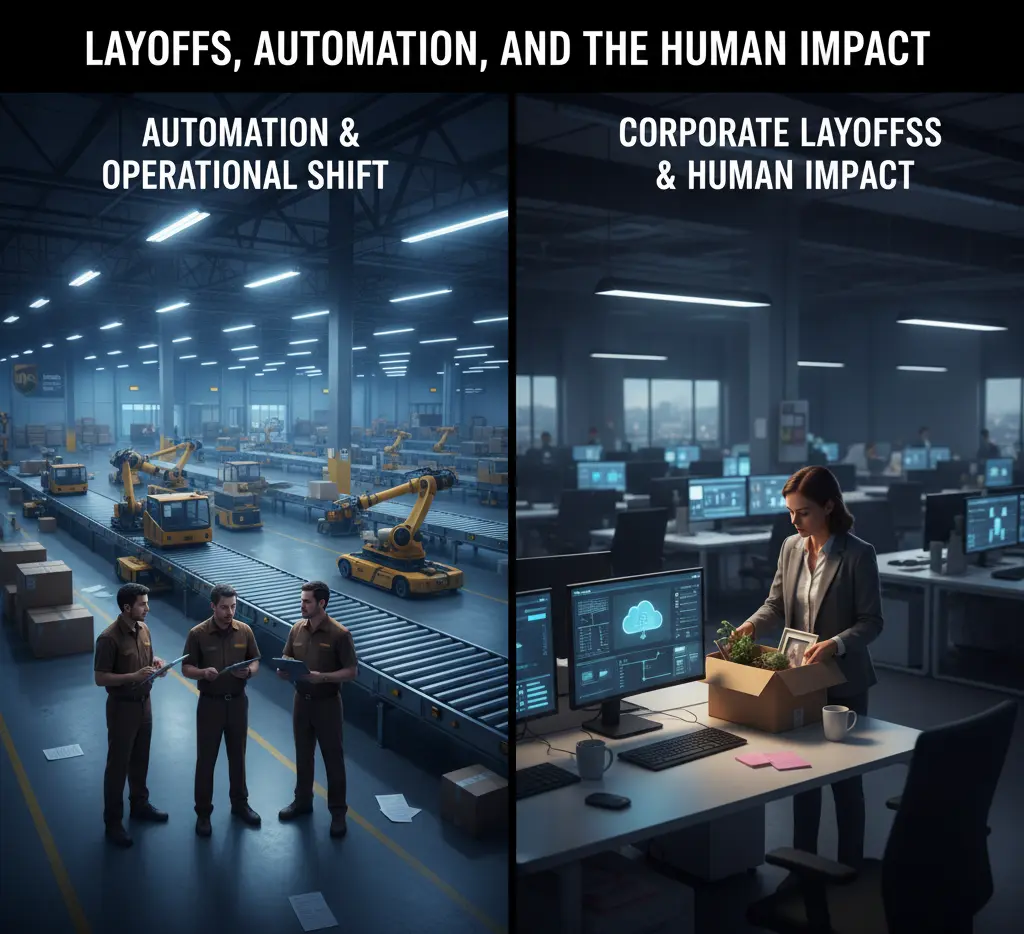
Introduction: Headlines of Layoffs
Open your feed on any random Tuesday and you will probably see it, another headline about layoffs. UPS trims tens of thousands. Job cuts and Amazon cuts corporate roles, again. It is easy to feel numb. It is also worth asking what, exactly, is happening under the hood, because these cuts are not just numbers. They are a story about automation, network redesigns, changing customer behavior, and companies trying to keep margins steady while the ground keeps shifting.
Want to understand trends in blue-collar employment? Read McDonald’s blue-collar job insights.
Why Companies Announce Job Cuts
There are a few honest reasons that show up in earnings calls, even when the press release hides behind bland phrases. UPS is shrinking and modernizing its network, which means closing buildings, pushing more volume through automated hubs, and recalibrating how much of Amazon’s freight it wants to touch. That combination takes headcount down, especially in operations and middle management, because machines now do some of the sorting and routing that humans used to do, and because the network itself is smaller than the pandemic peak. Amazon’s current cuts lean corporate, a bid to strip bureaucracy while pouring money into AI and cloud infrastructure, which is a classic “spend for the future, slim the back office right now” move.
Putting Real Figures on the Page
UPS disclosed about 48,000 job reductions this year, with roughly 34,000 in drivers and warehouse roles and about 14,000 in management, helped by a voluntary buyout program for full-time drivers and a sweeping facility consolidation that has closed or identified scores of buildings for closure. Executives framed it as the biggest strategic reset in the company’s history, and markets rewarded the promise of lower costs and a more automated network. Amazon, meanwhile, said it would eliminate around 14,000 corporate jobs in this round, with reporting suggesting the total could climb higher as the company keeps investing heavily in generative AI and data centers while trying to be “the world’s biggest startup” again.
See how industry-specific job markets are changing with this NYT driller job post.
The Logistics and Tech Dance
Logistics runs on throughput and precision. When a carrier like UPS routes more parcels through highly automated facilities, labor needs change. A single automated hub can replace the work of several smaller, older buildings, which is why UPS has been shuttering sites while boosting the share of parcels that move through automated processes toward two thirds of its volume. That efficiency story shows up in cost savings targets, which the company says are in the billions for the year, and in the idea that peak season can be “the most efficient in our history” because the machines are finally doing what they promised on the slide decks. This is not just robots replacing people. It is a structural decision to run a leaner, more centralized network in response to a long-term decline in Amazon volume on the UPS side and a broader normalization after the pandemic parcel boom.
On the tech side, Amazon’s cuts live next to massive capital spending on cloud and AI. If that sounds contradictory, it is not. The company is reallocating, trimming corporate roles in HR and other staff functions while doubling down on the businesses that drive future profits, AWS and AI infrastructure. That is why you see layoffs in white collar divisions at the same time the company hires hundreds of thousands of seasonal warehouse workers to get through the holidays. It is a tale of two Amazons, the corporate org chart getting tighter, and the operations engine swelling for peak.
Automation, AI, and the Human Impact
The easy narrative says AI replaces jobs. The real story is more tangled. Automation in warehouses does reduce the number of people needed to hit the same throughput, and decision support tools in routing centers let smaller teams manage bigger flows. At the same time, these systems introduce new roles in robot maintenance, data monitoring, safety, and exception handling. The net effect in 2025 looks like fewer frontline bodies per package and fewer layers of coordination per decision, which means companies can “do more with less” and tell investors a cleaner story about productivity. Some analysts argue firms also use AI as rhetorical cover for cuts driven by old-fashioned reasons, over hiring during the pandemic, slower consumer demand, and pressure to improve margins after a rough stock run. It can be both at once, real automation gains and real financial housekeeping behind the same headline.
How Layoffs Affect Workers and Industries
For workers, the immediate impact is brutal, income shocks, health insurance worries, and the emotional whiplash of going from all hands on deck to “your role is redundant.” For unionized segments like UPS drivers, buyouts soften the landing for some, though they also shrink pathways for younger workers who hoped to move up. In corporate tech teams at Amazon, severance and internal transfer windows help, but mid-career professionals still face a crowded market where many companies are making similar moves. Industry-wide, fewer buildings and more automation mean fewer entry points into logistics work in some regions, even as other areas see growth in higher-skill maintenance and systems roles. The geography of opportunity changes when a company closes a dozen local depots and pushes everything to a single mega hub two hours away.
UPS and Amazon in the 2020s
Both companies are symbols of larger patterns. UPS is the bellwether for parcel delivery. When it says Amazon volume is down more than twenty percent year over year and will be cut in half by 2026 as a share of its business, it is also saying the old dependency on one customer is too risky. The pivot is toward a network designed for profitability over raw volume, and toward automation that lets them promise consistent service with fewer people on the payroll. Amazon, for its part, is the bellwether for corporate tech and retail logistics. Every time it cuts staff in support functions while spending billions on AI and cloud, it signals to the market that headcount is not the KPI, operating leverage is. Expect peers to follow that playbook because investors keep rewarding it.
The Bigger Story: Global Employment Shifts
Zoom out and you see a few clear arcs. First, the pandemic pulled demand forward in e-commerce and remote services. The comedown forced companies to resize. Second, automation matured just enough to make consolidations pay off. That is why a building closure list can ride alongside a slide about robotics and still make sense to the finance team. Third, AI is the new capital expenditure magnet. Firms will cut payroll to fund it, then use it to justify more cuts. That feedback loop will continue until the returns flatten or regulation shifts the incentives. None of this is inevitable for any single worker. It is the weather pattern everyone is flying through.
What Job Seekers Can Learn Right Now
- Read signals early. When a company starts consolidating facilities or centralizing decisions into a new platform, start planning, even if your location is not on the closure list yet.
- Follow capital, not slogans. If leadership talks about “our biggest bets” and the budget points to AI and cloud, map your skills to those areas or to the functions that serve them, reliability, safety, compliance, and automation support.
- Aim for exception handling. The humans who thrive next to automation are the ones who solve edge cases, keep systems safe, and make judgment calls when the data is messy. That applies in warehouses, routing centers, and corporate roles alike.
- Guard your runway. If your company offers buyouts, get financial advice before deciding. If your team looks likely to be cut, apply internally while the window is open, then build an external pipeline fast.
Learn how professionals pivot amid job cuts by exploring Sparkle Megan’s wellness entrepreneurship.
Where Worker Protections Fit
Layoffs at this scale put pressure on safety nets, from severance norms to retraining funds. Unions will push to protect roles that can be protected, and to secure fair exits for roles that cannot. Cities and states often respond with workforce programs geared to automation adjacencies, robot tech, maintenance, data quality, and safety. The best of these programs align with where companies are actually hiring rather than where politicians wish they were hiring.
A Human Note to End
Job cuts land like thunder, then life keeps moving. For companies, they are a line in an earnings deck. For workers, they are dinner table math, rent, and the next morning’s job applications. The headlines about UPS and Amazon are not just about two brands. They are about how work changes when machines get smarter, when networks get leaner, and when leaders decide to pay for tomorrow by shrinking today. If you are inside that storm, take it personally enough to act, not so personally that it defines your worth. The skills that make logistics hum and tech teams run still matter. The trick is to aim them where the wind is blowing next.
1. Data Comparison Table: The Reset of 2025-2026
Frequently Asked Questions (FAQs)
-
Why did UPS cut 48,000 jobs?
To save $3.5 billion and shift away from low-margin business, specifically reducing reliance on Amazon. -
Are Amazon warehouse workers affected?
No, the current cuts are primarily in corporate and management layers; warehouse hiring remains seasonal. -
Is AI replacing logistics jobs at UPS?
Automation is a key driver, with new “Velocity” hubs requiring significantly fewer humans for sorting.